
Best Writing Software for Novelists| As of 2026

Every few months, someone asks in a writing forum: "What's the best software for writing a novel?"
The thread always turns into the same debate. Scrivener devotees insist nothing else comes close. Atticus users talk about how much cleaner it is. Someone mentions yWriter is free. Another person says just use Google Docs.
I've spent the last eight months building writing software and talking to hundreds of novelists about their workflows. Here's what I've learned: there is no universal "best" tool. There's only what works for how you write.
But the differences between tools matter, and they matter differently depending on what kind of writer you are.
What Actually Matters for Novel Writing
Before comparing specific tools, let's establish what features actually impact your daily writing:
Manuscript organization. Can you structure acts, chapters, and scenes? Rearrange them easily? See your whole project at once?
Character and world tracking. How do you manage character profiles, locations, timelines, and world-building details?
Cross-device writing. Can you write on your laptop, continue on your desktop, and edit on your tablet without file management headaches?
Export flexibility. How easy is it to get your manuscript into formats publishers or self-publishing platforms need?
Learning curve. How long before you're writing instead of watching tutorials?
Everything else—AI features, templates, collaboration—might matter to you or might not. But these fundamentals affect every novelist.
Scribeist: Modern Cloud Writing
Price: $8-14/month
Platform: Web-based
Best for: Writers who want character tracking with cloud sync and AI assistance
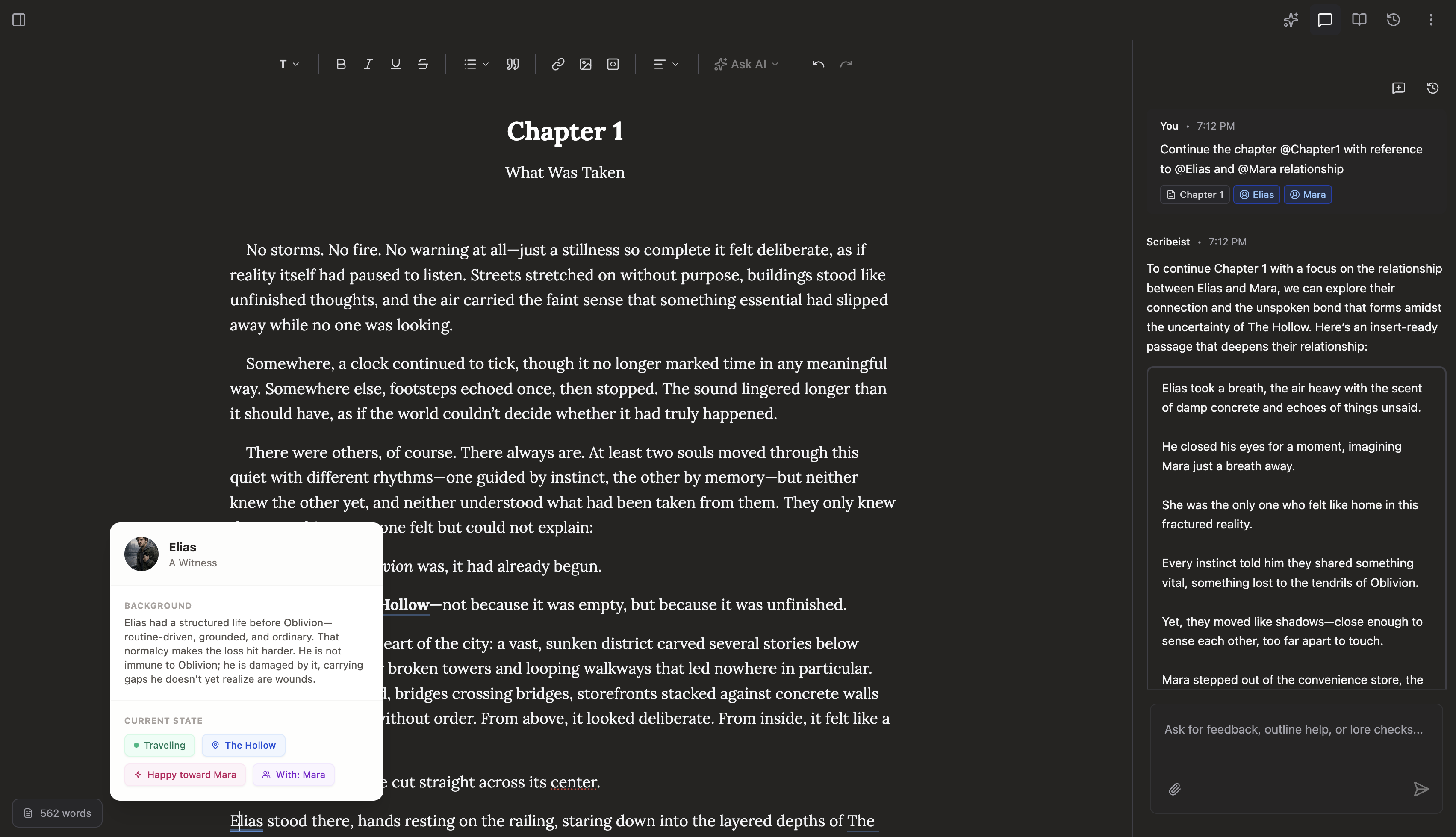
What Scribeist Does Well
Workspace-based approach
The Novel workspace includes character tracking (Mythos), timelines, and planning sheets. Blog workspace has SEO tools. Everything syncs automatically across devices.
Character and world tracking
Works like Scrivener's organization but with relationship mapping and color-coding built in. See where characters appear in your manuscript, track emotional arcs, and map complex hierarchies (kingdoms → cities → characters).
Context-aware AI
If you've tracked your characters and relationships, the AI knows them when you ask for help. It references your specific story details, not generic advice.
Where It Falls Short
It's new
Launched in early 2026. The feature set isn't as mature as tools that have been around for years.
Subscription model
Monthly payments add up. If you prefer one-time purchases, Scrivener or Atticus are more appealing.
Limited offline mode
Cloud-first design means writing without internet is problematic.
Who Should Use Scribeist
- Writers who work across multiple devices
- Authors who want AI assistance that understands their story
- People who write both novels and blog content
- Writers comfortable with subscription pricing
Who Shouldn't
- Writers who only work on one device
- Authors who don't need AI features
- People who prefer one-time purchases
- Writers who frequently work offline
Scrivener: The Industry Standard
Price: $60 one-time (Mac/Windows), $24 (iOS)
Platform: Mac, Windows, iOS
Best for: Writers who want complete control and don't mind complexity
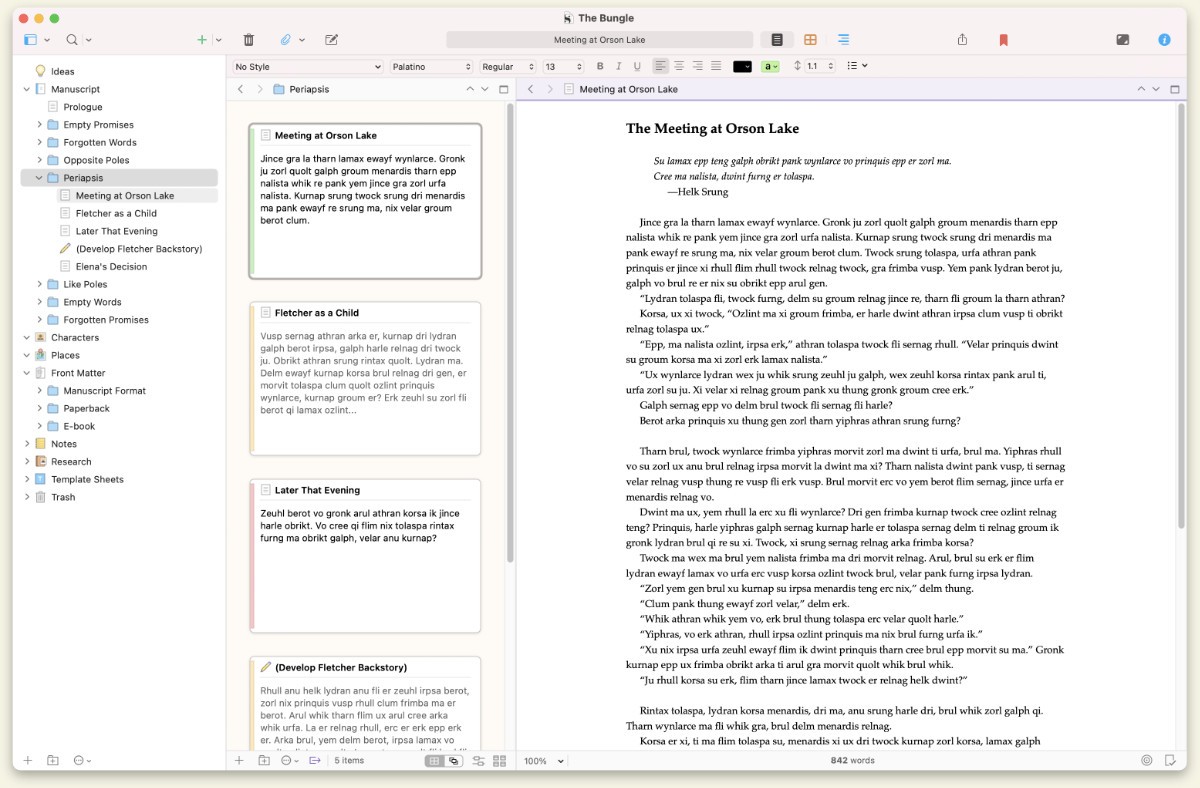
Scrivener has been the default answer for novelists for almost twenty years.
What Scrivener Does Well
Corkboard visualization
Drag and drop scenes as index cards, color-code by POV or status, see your entire story structure visually. Still one of the best plotting interfaces ever built.
Comprehensive research organization
Keep character notes, location photos, articles, inspiration images—everything inside your project file. No juggling browser tabs or separate documents.
Unmatched export control
Different formatting for ebooks vs print, custom chapter headers, automated front matter. If you need precise control over final output, Scrivener delivers.
Where It Falls Short
Steep learning curve
You'll spend hours watching tutorials before feeling comfortable. Some writers love that depth. Others just want to write.
Finicky cross-device sync
Uses Dropbox and requires careful management. Forget to close Scrivener on one device before opening it on another, and you'll get conflicts.
No collaboration features
Sharing with beta readers means exporting to another tool.
Who Should Use Scrivener
- Writers who value power over simplicity
- Authors who primarily work on one device
- People who need granular control over exports
- Writers willing to invest time learning complex software
Who Shouldn't
- Writers who want quick setup
- Authors working across multiple devices constantly
- People who need real-time collaboration
- Writers intimidated by feature-heavy software
Atticus: Modern Power Without Complexity
Price: $147 one-time
Platform: Web-based
Best for: Writers who want Scrivener's organization without the learning curve
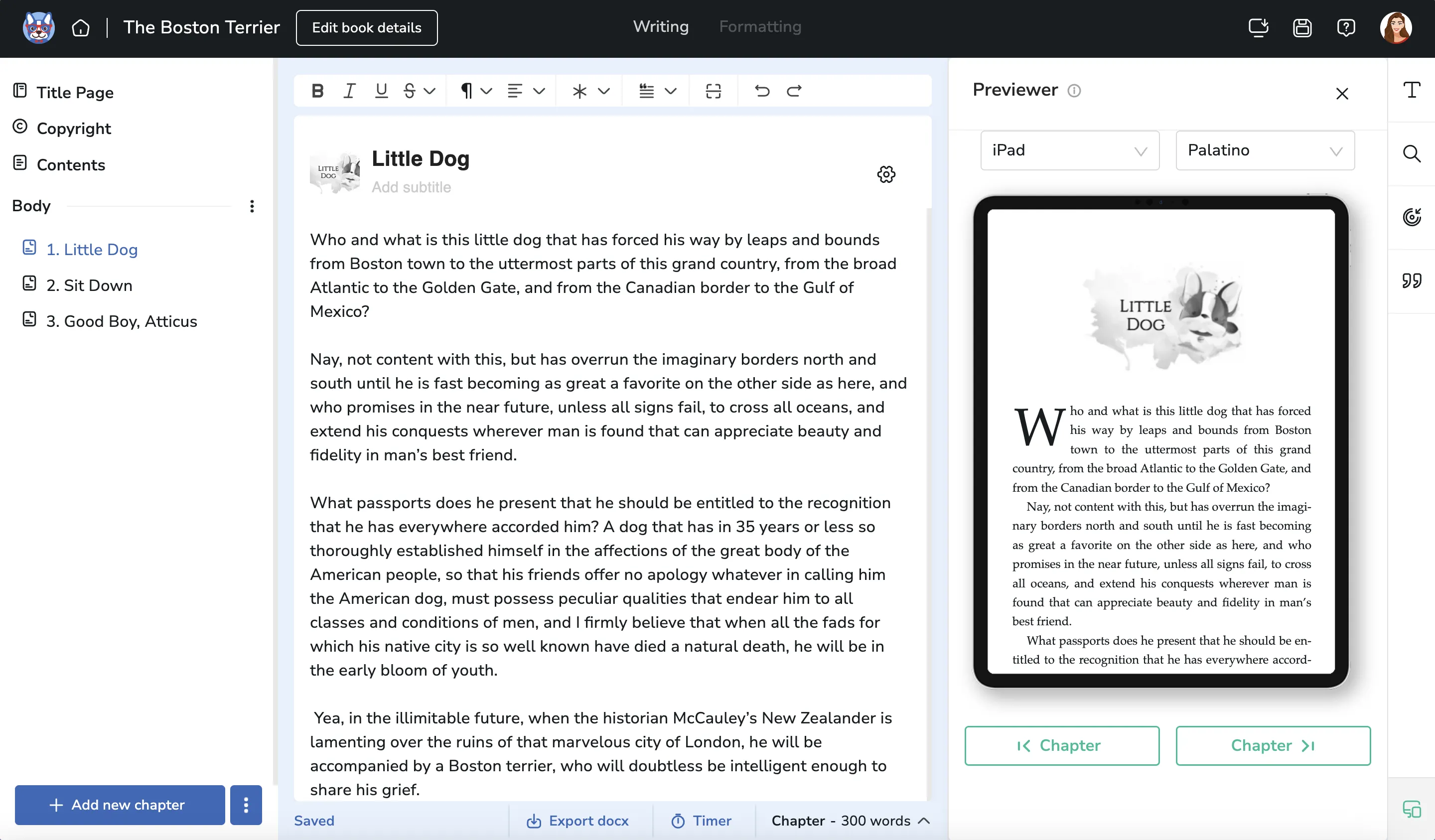
Atticus asks: what if Scrivener, but cleaner and simpler?
What Atticus Does Well
Intuitive interface
Figure out the basics in minutes instead of hours. Still powerful—outlining, character tracking, scene organization—but complexity is hidden until you need it.
Streamlined formatting
Built-in templates for common publishing formats. Go from manuscript to professional-looking book with minimal setup.
Automatic cloud sync
Write on your desktop, continue on your laptop, edit on your tablet—it's always there.
Where It Falls Short
Less customization than Scrivener
Can't tweak every setting or build complex export workflows. Power users notice the limitations.
Relatively new
Launched in 2021, so some advanced features are still being added.
Browser-only
No native mobile apps. Works on tablets but feels awkward on phones.
Who Should Use Atticus
- Writers who want powerful organization without complexity
- Authors writing across multiple devices
- People who value clean interfaces
- Writers comfortable with one-time purchases around $150
Who Shouldn't
- Power users who need Scrivener-level customization
- Writers who prefer native desktop apps
- Authors on very tight budgets
- People who need advanced export workflows
Novlr: Simplicity First
Price: $10/month or $100/year
Platform: Web-based
Best for: Writers who want minimal features and maximum focus
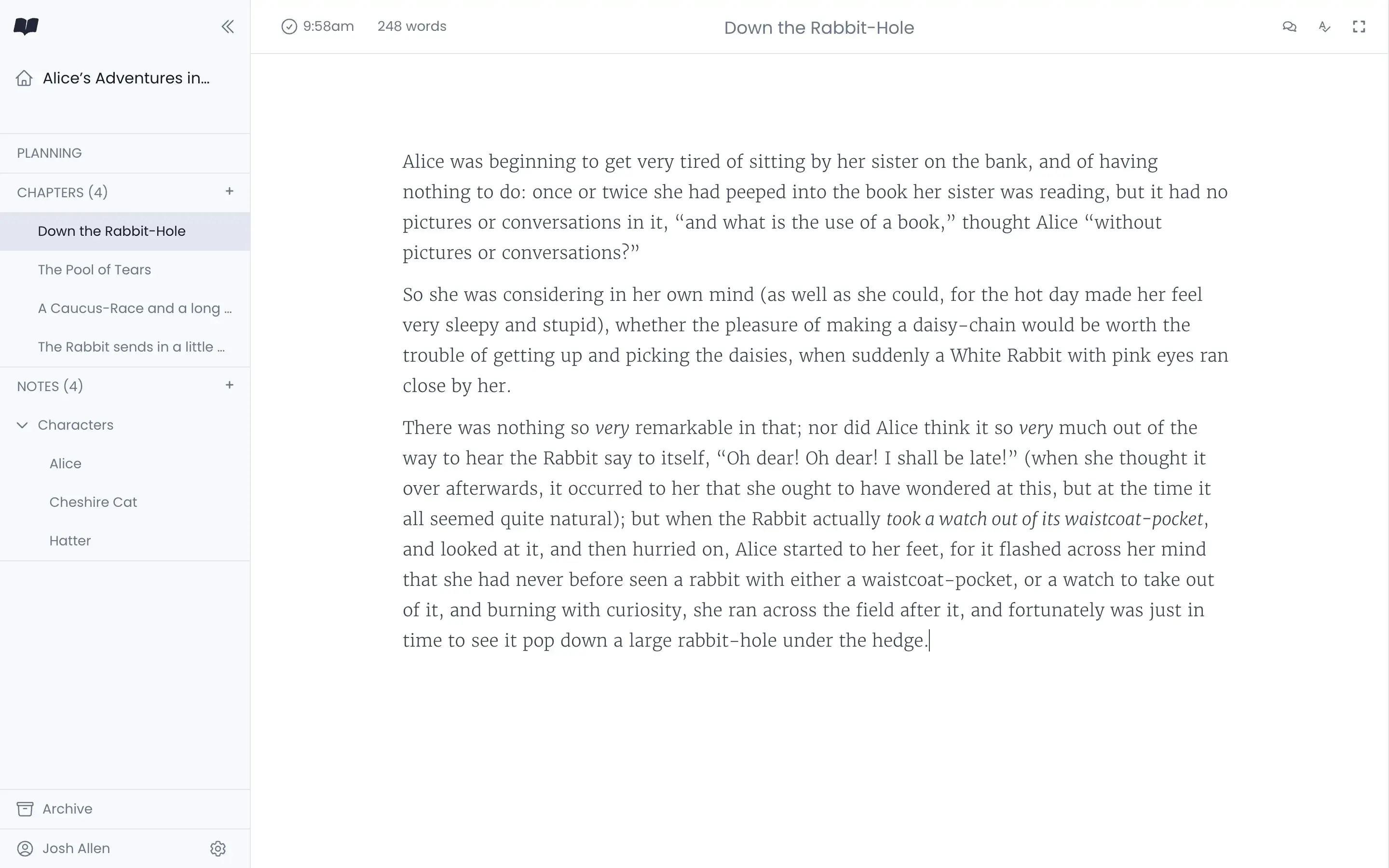
Novlr strips away everything that isn't directly about writing your novel.
What Novlr Does Well
Clean writing experience
Distraction-free interface, automatic sync, write from anywhere with internet.
Built-in goal tracking
Daily word count targets, progress monitoring, reminders for writers who need structure.
Active community
Discord groups for support, writing sprints, and feedback.
Where It Falls Short
Limited organization
Compared to Scrivener or Atticus, outlining and scene management is basic.
Basic export options
Get Word docs or PDFs, but no fine-tuned formatting control.
Subscription costs add up
$100/year doesn't sound like much, but over time exceeds one-time purchases.
Who Should Use Novlr
- Writers who find feature-heavy software overwhelming
- Authors who want simple, focused writing environment
- People who value community support
- Writers who need goal tracking and accountability
Who Shouldn't
- Authors with complex plotting needs
- Writers who need advanced organization tools
- People who prefer one-time purchases
- Authors who need precise export control
Campfire: For World-Builders
Price: $50/year or modular pricing starting at $0.50/month
Platform: Web-based
Best for: Fantasy and sci-fi writers with complex worlds
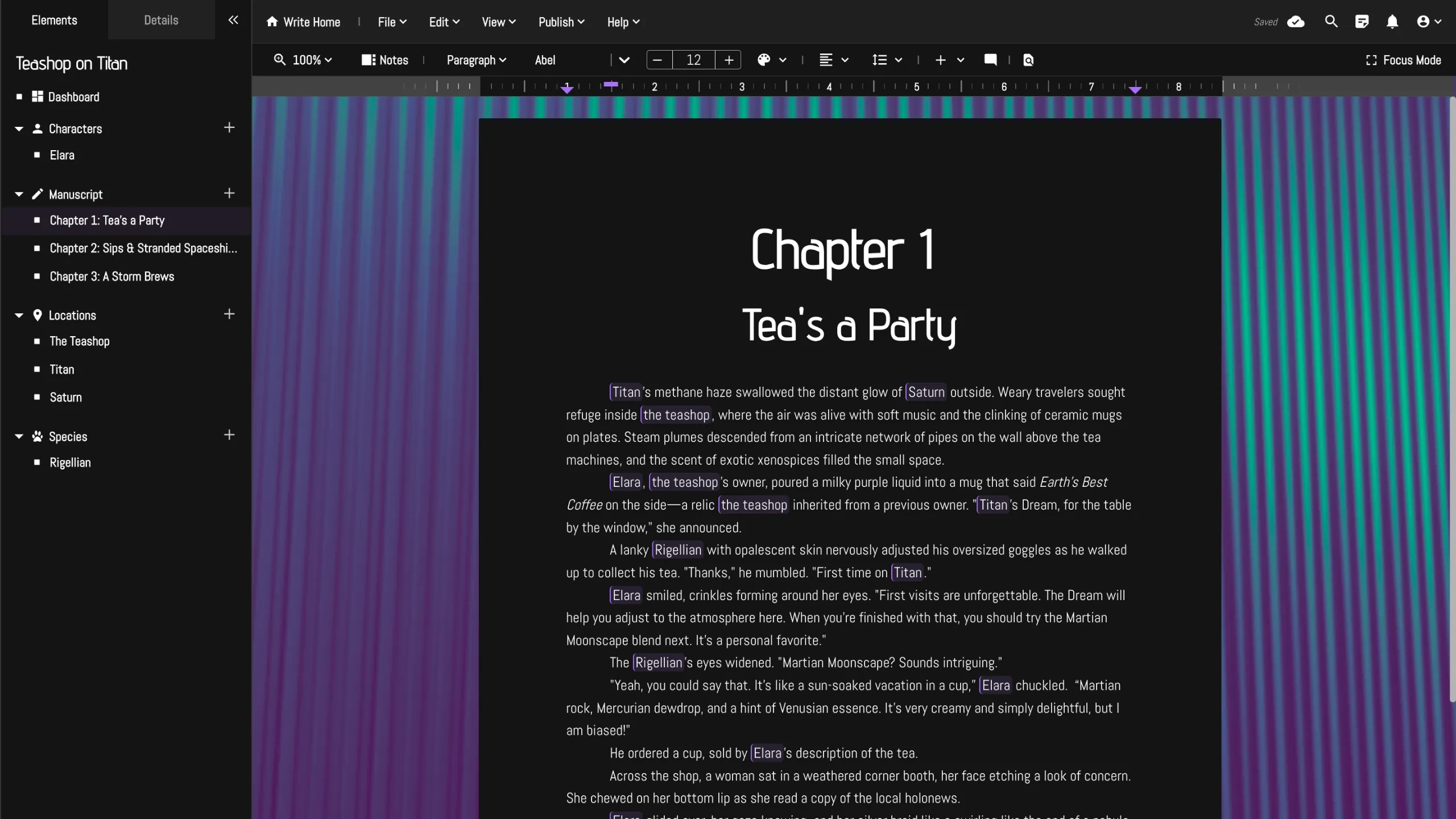
Campfire focuses on world-building rather than manuscript writing.
What Campfire Does Well
Extensive world-building tools
Character profiles, maps, magic systems, timelines, relationship mapping—all designed for speculative fiction.
Modular pricing
Pay only for features you need. Don't need maps? Don't pay for maps.
Visual organization
Relationship mapping and visual connections between elements.
Where It Falls Short
Basic writing interface
Campfire is for planning, not drafting. You'll write your manuscript elsewhere.
Can be overwhelming
Seventeen different modules means lots to learn.
Procrastination risk
Easy to spend hours world-building instead of writing.
Who Should Use Campfire
- Fantasy and sci-fi writers with complex worlds
- Authors who need detailed magic systems or politics
- Writers who separate planning from drafting
- People comfortable with world-building before writing
Who Shouldn't
- Contemporary fiction writers
- Authors who want to write and plan in the same tool
- People prone to over-planning
- Writers on very tight budgets
Google Docs: The Universal Default
Price: Free
Platform: Web-based, mobile apps
Best for: Writers who don't want specialized software
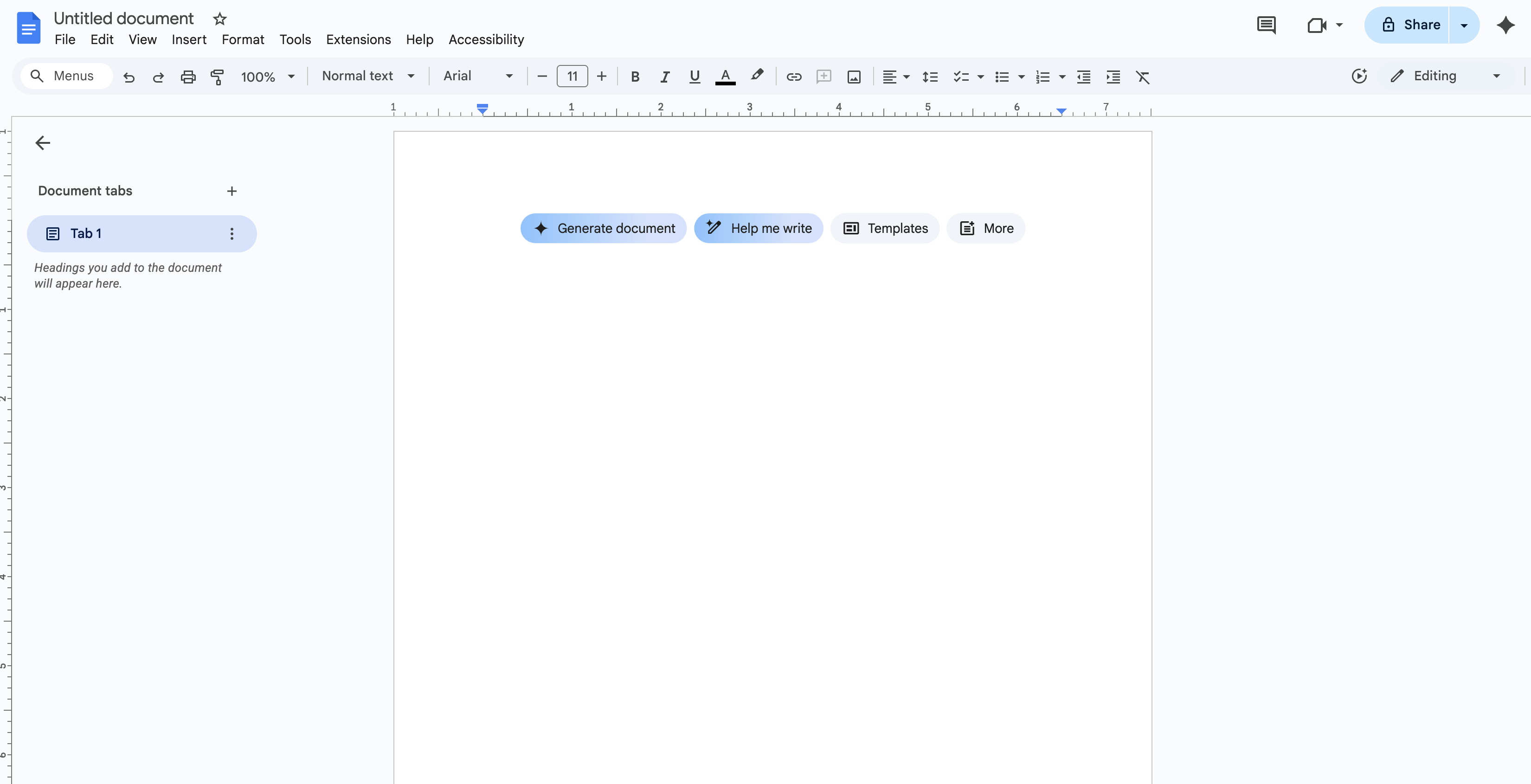
Some novelists write entire books in Google Docs.
What Google Docs Does Well
Zero learning curve
You already know how to use it.
Native collaboration
Share with beta readers, accept comments, track changes—all built in.
Free and everywhere
Works on any device with a browser.
Where It Falls Short
No manuscript organization
Beyond folders, you're on your own for structure.
No specialized features
No character tracking, scene rearrangement, or publishing templates.
Limited formatting control
Getting manuscripts print-ready requires workarounds.
Who Should Use Google Docs
- Writers who find specialized software unnecessary
- Authors prioritizing collaboration over features
- People on very tight budgets
- Writers who want zero learning curve
Who Shouldn't
- Authors with complex manuscripts
- Writers who need character tracking
- People who want professional formatting
- Authors writing novels over 50,000 words
How to Actually Choose
Stop asking "what's the best?" and start asking "what problems do I have?"
If your problem is: "I lose track of characters and plot threads"
Consider: Scrivener, Atticus, or Scribeist
If your problem is: "I write across multiple devices and sync is painful"
Consider: Any cloud tool (Atticus, Novlr, Scribeist, Google Docs)
If your problem is: "Software is too complicated"
Consider: Novlr or Google Docs
If your problem is: "I need world-building organization"
Consider: Campfire (plus another tool for actual writing)
If your problem is: "I can't afford software"
Consider: yWriter or Google Docs
The Honest Answer
Most writers would be fine with any of these tools. The differences matter less than you think.
Try free trials. Most offer them. Spend a week actually writing, not exploring features. Notice what feels smooth and what creates friction.
Then choose based on that, not based on what other writers tell you to use.
The best writing software is whichever one gets out of your way and lets you write. Everything else is procrastination disguised as productivity.